
¿Cómo estás?
Hola a todos. ¿Cómo estás?, es una pregunta que te van a hacer muy a menudo cuando vengas a España. ¿Sabes cómo tienes que responder?
En esta lección de español te vamos a enseñar varias expresiones con las que puedes responder a esta pregunta. Seguro que dejas impresionados a tus amigos.
Los españoles usamos el verbo ESTAR para describir nuestros estado mental o físico. Por ejemplo:
- Estoy bien, gracias.
- Estoy mal, no me encuentro muy bien.
ATENCIÓN: no usamos el verbo SER.
Otra manera de responder a la pregunta, ¿cómo estás o cómo te encuentras?, es con el verbo reflexivo ENCONTRARSE:
- Me encuentro bien, gracias.
- No me encuentro bien.
En algunos casos también utilizamos el verbo TENER para expresar sensaciones físicas:
- Tengo frío.
- Tengo calor.
- Tengo hambre
- Tengo sed.
También puedes utilizar estas expresiones para decir cómo te sientes.
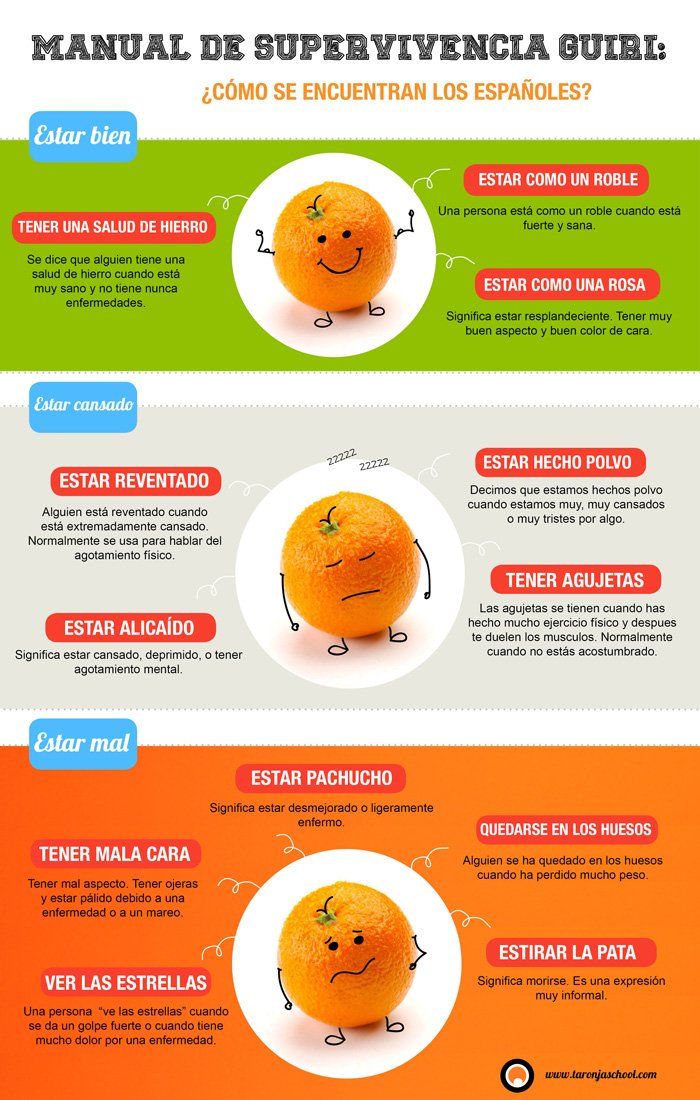
Ahora que sabes cómo responder cuándo alguien te pregunta «¿cómo estas?«, recuerda que tienes que conjugar los verbos. Por ejemplo:
Tener mala cara -> (yo) tengo mala cara. (tu) tienes mala cara.
[h5p id=»3″]
Expresiones relacionadas

Aprende español con Taronja School
Con nuestros cursos de español puedes mejorar tu expresión oral y aprender de una forma divertida y amena cómo somos los españoles.
¿Qué opinan nuestros alumnos de nuestros cursos de español?
Estas son algunas de las opiniones de nuestros alumnos. ¡Los premios nos los dais vosotros!
It is easy to make friends, which is important if you are coming here on your own (like me) and there were social acitivties every night. These ranged from paella nights, language exchanges, and generally drinking and socialising. Always fun. I was here in summer which would offer a bigger social life compared to low-season/ winter etc.
The lessons are varied and you use handouts, quiz games, group tasks, videos, songs, etc, in order to learn in a varied way.
I would recommend to anyone who values a more fun and social atmosphere to learn and I definitely feel like I improved a lot. In 2 months, I went from a low A2, to a B1 level, and I had a lot of practice actually speaking the Spanish that I had learned.
The teachers at Taronja are young, fun and competent people. Rather than forcing us to fill out boring and repetitive exercise sheets, they make learning more enjoyable by providing innovative activities and games to keep the classroom engaged. The timetable is constantly rotating, so we can benefit from various styles and techniques of each teacher.
Valencia is a truly beautiful city in a variety of different ways. The centre of the city is built around two lively squares, made up of old monuments, statues, restaurants, and constant buzz of passing tourists. The surrounding streets are full of character and are brought to life by the detail of their design, the classical Valencian balconies, and the numerous restaurants. The Turia park is another incredible feature of the city. It used to be a large river flowing through the centre of the city, but people decided to drain it after serious floods in the 1950s. Now, it is a riverbed, which has been converted into a lush garden, where people go to escape the city, exercise and relax.
Da ich weiter dranbleiben werde, Spanisch zu lernen, ist es für mich sofort klar gewesen, dass ich heuer wieder die Taronja besuchen werde. Vielleicht treffe ich ja heuer sogar einen, der meine Bewertung gelesen hat in Valencia - würde mich freuen 🙂
Ich hoffe, ich konnte euch mit meiner Bewertung helfen und dass ihr auch so eine geile Zeit, wie ich sie hatte, in Valencia verbringen könnt.
P.s.: Für alle die die la tomatina (Das Tomatenfest, wo man sich einfach aus Spaß mit Tomaten bewirft) nur aus dem Fernseher kennt, habt ihr auch hier die Möglichkeit Ende August dabei zu sein, denn die Schule organisiert Bus und Verpflegung 🙂
Hasta luego :)))))