
Diferencias entre «allá», «haya», «halla»

«Allá», «haya», «halla», seguramente has oído estas palabras que tienen significados completamente diferentes. En esta lección te explicamos las diferencias.
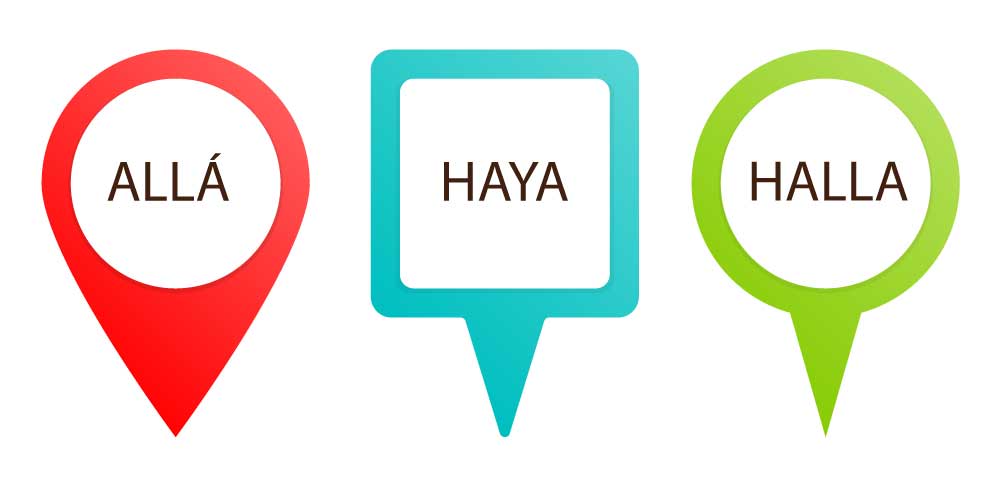
Alla, haya, halla en español.

De estas tres palabras, “allá” es la más fácil de distinguir, por su grafía que lleva una tilde, y su pronunciación aguda. Sin embargo, “halla” y “haya”, son palabras que la mayoría de hispanohablantes pronuncian igual. 

Vamos a conocer estas tres palabras un poco mejor. 

“HALLA”

Es una forma del verbo «hallar”, que significa encontrar a alguien o algo. Descubrir una verdad o entender una cosa después de pensar y reflexionar sobre ella. 

Equivale a la tercera persona de singular del presente indicativo y a la segunda persona de singular del modo imperativo.

El verbo “hallar” también se puede encontrar muchas veces en su forma reflexiva “hallarse” (equivalente a encontrarse).

Presente de indicativo

(yo) hallo

(tú) hallas

(él) halla

(nosotros) hallamos

(vosotros) halláis

(ellos) hallan

Imperativo

(tú) halla

(él / ella )halle

(nosotros) hallemos

(vosotros) hallad

(ellos) hallen

Ejemplos:

Ella siempre halla la manera de escaparse de los problemas / Ella siempre encuentra la manera de escaparse de los problemas. 

Me hallo en medio de un bosque muy especial / Me encuentro en medio de un bosque muy especial. 

“HAYA”

Ahora se trata de una forma de la conjugación del verbo “haber”. La primera y la tercera persona del presente de subjuntivo. Y sus principal función es aparecer como auxiliar en tiempos compuestos.

Presente de subjuntivo

(yo) haya

(tú) hayas

(él) haya

(nosotros) hayamos

(vosotros) hayáis

(ellos) hayan

Ejemplos:

No creo que haya víctimas en el accidente.

Cuando haya comido iré a verte. 

Cuando hayas visitado a tu madre me avisas. 

Cuando hayas terminado el trabajo tienes que ir a comprar. 

Explíquenos lo que haya visto.

Que haya paz en el mundo. 

Como último apunte, “haya” puede referirse a un nombre de árbol. 

Me gusta mucho el haya de tu jardín. 

“ALLÁ”

Es un adverbio de lugar y se emplea para indicar un lugar que está alejado de nuestra posición.  Al llevar una tilde en su forma escrita y pronunciarse de manera aguda, no es complicado distinguir la palabra “allá” en una frase.

Ejemplos:

Allá está la casa de mis hermanos. 

¿Aquello de allá es un ciervo?

Ejercicios

[h5p id=»4″]

¿Quieres saber tu nivel de español?

Aprende español con Taronja School


Con nuestros cursos de español puedes mejorar tu expresión oral y aprender de una forma divertida y amena cómo somos los españoles.

¿Qué opinan nuestros alumnos de nuestros cursos de español?


Estas son algunas de las opiniones de nuestros alumnos. ¡Los premios nos los dais vosotros!

Diferencias entre "allá", "haya", "halla" 2
Jordan Cookson Avatar
Jordan Cookson
I just spent 11 weeks at Taronja and loved every minute of it. The classes were fun and engaging and my Spanish improved a lot. You have 2 different teachers each week so you get to experience different teaching styles, they also have activities 6 days a week so you have the chance to socialise outside of school hours and get to know the other students and teachers. I loved it that much that I’m going back for another 5 months in February, I couldn’t have asked for a better experience and would recommend this school to anyone who’s looking to learn Spanish and also meet lots of new people.
leer más
sarahgF783ZM
5 star rating
leer más
Roderick C Avatar
Roderick C
5 star rating
Great Week at Taronja Both my children have been to Taronja to work on their their Spanish (my daughter four times so far) and have both made excellent progress. Then, at long last, Dad made it too! I was looking for an advanced course, which can be difficult to find in smaller schools so it was great to find somewhere that can offer courses at a more demanding level, and even better, that are well taught. All this was backed up with daily printouts of the topics and new vocabulary that arose as we went along. Plenty of great extracurricular laid on outside the formal teaching. Inevitably this was better suited for those a wee bit younger than myself but my two (18 and 21) had an absolute ball! I opted to stay with a Spanish family and was very lucky to be assigned someone who was not only great company but who upon discovering it was my birthday, even laid on a birthday party for me!
leer más
Paola Campanelli Avatar
Paola Campanelli
Fantastic friendly school with perfect service. ¡Me gustó todo!!
leer más
Markus Mengelkamp Avatar
Markus Mengelkamp
Sehr gute Schule mit engagierten Lehrern. Tolle Stimmung. Viel gelernt.😄
leer más
Kitty Durinck Avatar
Kitty Durinck
Heel leuke ervaring, een super team leerkrachten en medewerkers, heel veel bijgeleerd....een aanrader !
leer más
Jacqueline Los Avatar
Jacqueline Los
The school is fantastic. The way of teaching is very creative! They keep your attention for the whole time you are in the class. For me it was 4 weeks, I'm 63 years old, I think 3 would have been better. You get lots of information. So the last week I was very very tired. There are nice activities and they are open for activities ask for by the students. Young and old is spread out over all the class rooms. It is very easy to get in contact with the younger people. I would like to do it again. València is the best city ever. Big, compact, beautiful atmosphere and wonderful to bike around. There are beautiful bike pads and people in cars take care of you when you are on a bike. Hasta luego!!!!
leer más
sophie e Avatar
sophie e
5 star rating
Brilliant school, good activities Absolutely brilliant, I've attended other schools to learn Spainish, and by far is the best. Good teachers, good learning pace, lots of vocab work and lots of opportunities to practice speaking. Classes are good mix of grammar, and practical things to say and there out of school options are by far the best. If you're learning in Valencia this is the school I recommend to study at by far!!
leer más